
Oops, Ouch, Thank You: Your Roadmap to Authentic Workplace Apologies
Ever been in a meeting where someone used the wrong pronouns for a colleague? The tension is palpable. Now, imagine a workplace where these slip-ups become stepping stones to growth. Welcome to the "Oops, Ouch, Thank You" approach – a game-changer in handling mistakes and fostering belonging.
Let's explore how this simple method can transform your workplace, one "oops" at a time. But first…
Self-Correcting as the First Step
Before we launch into an apology tool, let’s talk through what to do first. This is how you could handle a mistake:
If you hear yourself use the wrong name or pronouns for someone, rephrase and move on.
If someone else corrects you, say “Thank you,” self-correct, then keep going.
“This is Elliot – I mean Riley. Riley is joining our team next month.”
When Someone Corrects You
You could vary it up by referring to the following list:
Thank you.
Thank you, I’ll work to do better.
Thanks for correcting me.
Thanks for the reminder.
Thanks for your patience.
Thank you for letting me know.
Why Aren’t We Apologizing Yet?
Participants often ask in workshops if it’s rude not to apologize when a mistake is made. If the person impacted by the uh-oh moment is correcting you, an unfair burden may often be placed on them to self-advocate and educate others. It’s exhausting emotional labor, and that’s why sometimes folks don’t speak up or correct folks. However, they likely hear the mistakes every time.
In online discourse, you may see transgender and nonbinary individuals talk about how when someone apologizes by saying “I’m sorry,” an additional pressure to say “no worries” or assure the person it’s OK can make matters worse. They may still be reeling from the emotional impact of the mistake and shouldn’t be made to feel that they need to soothe or forgive you.
By simply saying thank you, like in the variations further above, we:
Keep the focus on whatever is happening, such as a meeting, not drawing further attention to it.
Demonstrate taking responsibility for our actions.
Role model for others what they can do.
Remind ourselves that feedback is a gift.
At times, we may need someone to act as a mirror for us so that we can do better. We might not always hear when we make a mistake, so these are some ways we can address it. Similar to correcting and moving on, thank the person and do better. This shows gratitude for the correction or education.
Mastering the "Oops, Ouch, Thank You" Method
This three-step approach evolved from the traditional "Oops, Ouch, I'm Sorry" model in community organizing spaces, shifting focus from mere apology to active gratitude and growth. We use this tool when a series of mistakes have been made, such as misgendering, using the wrong name, or something similar.
Here's the breakdown:
Oops: Acknowledge and own the mistake without defensiveness.
Ouch: Recognize the impact on others.
Thank You: Express gratitude for their patience and what you’ll do to avoid it in the future.*
*Don’t promise you’ll never make the mistake again; it’s not setting a realistic expectation. You’ll set both of you up for failure.
Unlike awkward traditional apologies and non-apologies, this method emphasizes accountability and learning. Now, to clarify, we don’t literally say “Oops, Ouch, Thank you” to someone. Rather, it’s a framework for building our apology with sincerity and thoughtfulness.
Why Traditional Apologies Often Fall Short
We've all been there – receiving a half-hearted "sorry," that leaves us more frustrated. But why do these apologies miss the mark?
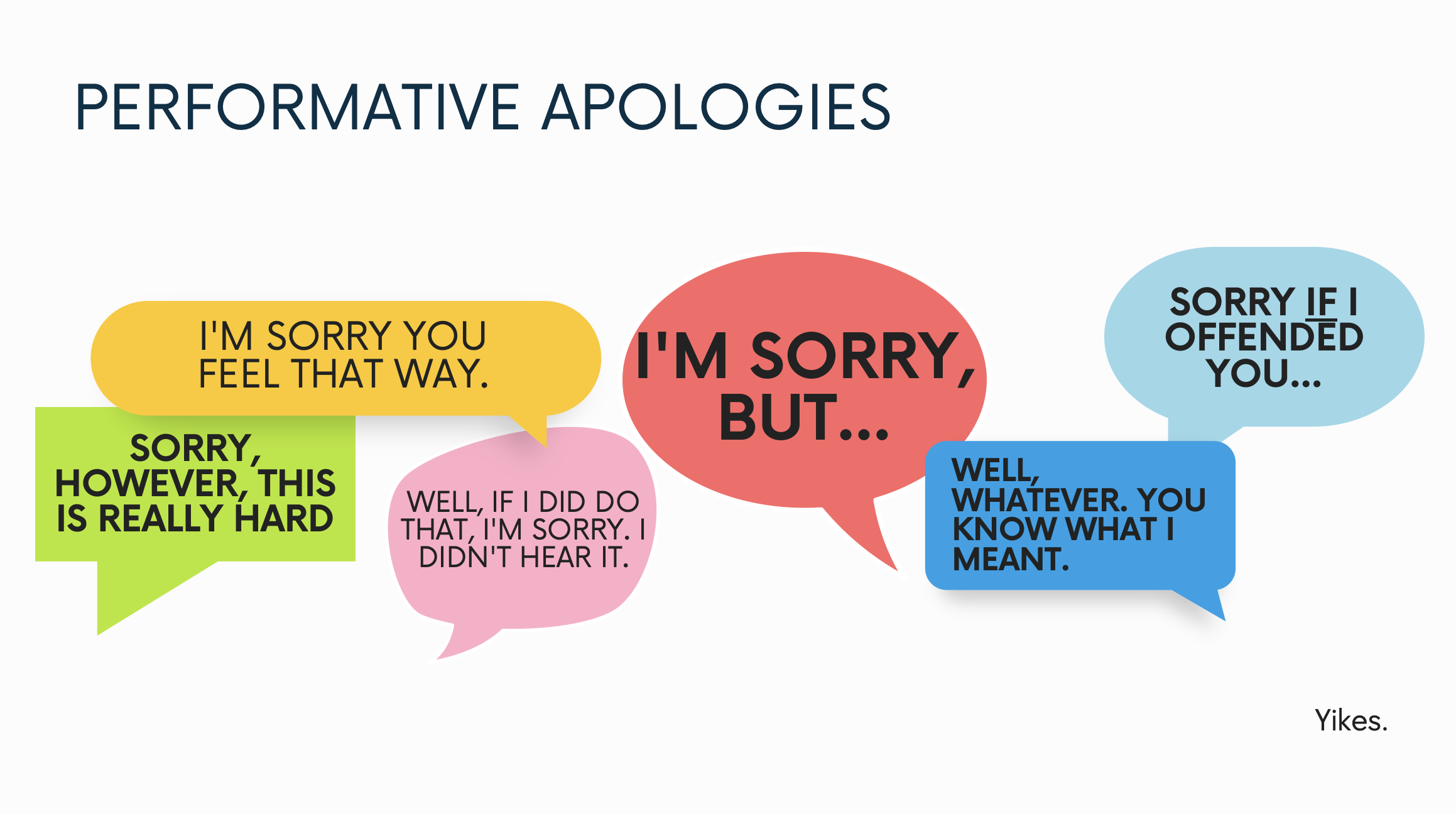
Common Pitfalls in Apologizing
Defensive reactions: "But I didn't mean to!" “You know I didn’t mean that.”
Over-apologizing: Saying sorry repeatedly without changing behavior, often also causing a scene.
Insincerity: Offering a quick "my bad" without understanding the harm caused. Not getting why it’s a “big deal.”
Dismissive remarks: “I’m sorry you feel that way.” “You should really be over it by now.”
Asking for something: “I’m so sorry; I hope you can forgive me.”
These reactions can make the hurt person feel dismissed or burdened with comforting the apology. “Buts” immediately void any apology. Apologizing week after week becomes meaningless.
The Impact of Ineffective Apologies
Poor apologies have far-reaching consequences.
The domino effect includes:
Damaged relationships
Emotional toll on marginalized individuals
Toxic workplace culture
The Power of "Oops, Ouch, Thank You" in Practice
Let's see how this method works in real life:
Step-by-Step Guide
Oops: "I realize I just misgendered you. That was a mistake on my part."
Ouch: "I understand that must have been hurtful and invalidating."
Thank You: "I appreciate your patience, and I will practice more moving forward."
Real-World Examples
Scenario 1: Using incorrect pronouns in a meeting and realizing it a few hours later.
Oops, I used the wrong pronouns for Alex again. Ouch, that must have been uncomfortable.
Ask to chat somewhere privately: "Hey, do you have a moment to check in? I wanted to acknowledge that I haven’t been great about using your name and pronouns. I recognize that it doesn’t feel good for you when you get misgendered, and I am taking steps to be better about it. I appreciate your patience.”
Scenario 2: Assuming someone's sexual orientation and being corrected in the moment.
Oops, I shouldn't have assumed she has a husband. Ouch, that assumption must be frustrating.
“I imagine it must feel invalidating every time someone makes that assumption about your relationship. Thank you for helping me recognize my bias. I'll work to be more inclusive in my language going forward."
Benefits of Implementing "Oops, Ouch, Thank You"
Adopting this method is like upgrading your personal operating system:
Increased accountability
Enhanced empathy
Stronger relationships
More inclusive workplace
Overcoming Challenges in Adopting the Method
Change can be tough, but here are some strategies to help:
1. Practice self-compassion: Focus on growth, not perfection.
2. Role-play scenarios: Practice with trusted colleagues to build confidence.
3. Start small: Begin with low-stakes situations.
4. Seek feedback: Ask for input on how you're implementing the method.
5. Create visual reminders: Use posters or desk cards with the steps.
Remember, the goal is progress, not perfection.
Conclusion
The "Oops, Ouch, Thank You" method transforms mistakes into growth opportunities. By implementing this approach, you create a more inclusive, empathetic workplace where everyone feels valued.
Ready to level up your allyship and communication skills? Start practicing today and watch your relationships and work environment flourish.
And if you're hungry for more LGBTQ+ inclusion tips, tune into the "Allyship is a Verb" podcast. Hosted by Charlie Ocean, it's packed with inspiring stories, practical advice, and just the right amount of humor. Check it out at https:/www.allyshipisaverb.com and turn your allyship journey into a grand adventure!
FAQs
1. Q: What if I'm not sure I made a mistake?
A: Ask for clarification. Try saying, "I'm not sure if I misspoke. Could you help me understand if I said something inappropriate?"
2. Q: How can I remember to use this method in the moment?
A: Practice regularly and consider creating a small reminder note on your phone.
3. Q: What if someone doesn't accept my apology?
A: Respect their feelings and give them space. We don’t apologize for forgiveness. Focus on changing your behavior moving forward, as that’s the best apology.
4. Q: Can this method be used outside of LGBTQ+ contexts?
A: Absolutely! It's valuable in any situation where mistakes and learning occur.
5. Q: How do I encourage my team to adopt this method?
A: Lead by example and consider incorporating it into team training or meetings.