
They/them mayhem: a brief history of a "rule" that was never really a rule
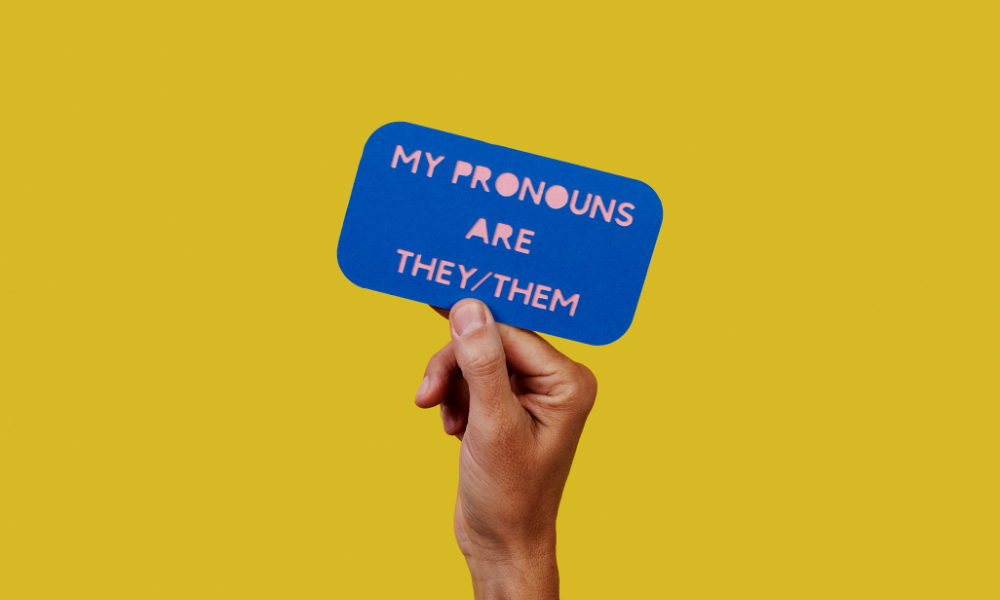
Let’s get this out of the way up front: if you’ve ever said “someone left their umbrella in the lobby,” congratulations. You’ve already used singular they. You’ve been using it your whole life. We all have.
So why does it suddenly feel controversial when a nonbinary colleague asks to be referred to the same way?
Spoiler: the controversy isn’t really about grammar. It never was.
It’s 650 years old. Yes, really.
The Oxford English Dictionary traces singular they all the way back to 1375, in a medieval poem called William and the Werewolf.1 And since spoken language usually predates written language, linguists believe it was probably in common use even before that.1
Here’s a quick tour of who was using singular they long before anyone decided it was a problem:
1386 Geoffrey Chaucer uses it in The Canterbury Tales2
1590s William Shakespeare uses it in Hamlet, A Comedy of Errors, and others2
1814 Jane Austen writes in Mansfield Park: “I would have everybody marry if they could do it properly.”3
1375 to 1800s Singular they is widely used in everyday speech and serious literature, and no one bats an eye
Chaucer. Shakespeare. Austen. Not exactly a crowd known for sloppy English.
So where did the “rule” against it come from?
In the 18th century, a wave of grammarians decided English needed to be formalized, and they did it by borrowing heavily from Latin. Bishop Robert Lowth published his influential grammar guide in 1762. Lindley Murray followed in 1795, copying extensively from Lowth and adding his own strictures.4 Their books became the standard texts in English and American schools for generations.
The problem? Their ideas of “correct” English were based on Latin grammar rules, not on how English actually worked.5 This gave us classics like “don’t split an infinitive” and “never end a sentence with a preposition.” Both invented. Both Latin imports. Both now largely ignored by every major style guide.
The “singular they is wrong” rule was born from the same thinking: a plural pronoun can’t have a singular antecedent, they argued. Logic!
Except...
The same grammarians apparently forgot that you used to be strictly plural too. The singular form was thou. When singular you took over in the 1600s, a Quaker named George Fox wrote an entire book calling anyone who used it an “idiot or a fool.”1 We now use singular you approximately one million times a day and nobody has a problem with it.
The anti-they rule also spread because it was useful as a class marker. During the Industrial Revolution, people climbing the socioeconomic ladder wanted to signal their education and refinement, and “correct” grammar was one way to do it. Speaking “properly” meant following the rules, even the made-up ones. Especially the made-up ones.6
Here’s the part where everyone backpedals
By the late 20th century, linguists and style guides started catching up to what English speakers were already doing. It turns out you can’t really police a word out of existence when literally everyone uses it instinctively.
The former chief editor of the Oxford English Dictionary, Robert Burchfield, put it plainly: objections to singular they are “unsupported by the historical record,” and the trend is “irreversible.”1 His words, not mine, though I’ll happily borrow them.
Since then, the dominoes have fallen pretty steadily:
1998 The New Oxford Dictionary of English not only accepts singular they, they use it in their own definitions1
2015 The Washington Post adopts singular they; the American Dialect Society names it Word of the Year7
2017 The AP Stylebook officially accepts singular they7
2019 Merriam-Webster makes singular they its Word of the Year2
Now Language evolves. So do people (hopefully).
Here’s the thing about language: it has never been static. It changes because people change, because communities shift, because needs evolve, because new words and new uses fill gaps that didn’t have names before. The only languages that stop changing are the ones nobody speaks anymore.
Singular you replaced thou. Awful used to mean full of awe, as in genuinely inspiring. Silly once meant blessed. Language bends toward the people who use it, not the other way around.5
And here’s the part worth sitting with for a second: even if someone could make a watertight grammatical argument against singular they (and they can’t, but even if), it still wouldn’t be the most important thing in the room.
People are more important than grammar rules. Full stop. When someone tells you how they'd like to be addressed, the question isn't "but is it technically correct?" The question is: do I want this person to feel seen, or do I want to win a debate with a dead bishop?
Getting someone’s pronouns right is one of the lowest-effort, highest-impact things you can do as an ally. It costs nothing. It signals everything.
Still feeling a little wobbly about it? That’s okay.
Look, if you were taught the “singular they is wrong” rule your whole life, it can feel weird to unlearn it. That’s not a character flaw. That’s just how deeply grooved habits work.
Here’s what helps: practice in low-stakes moments. Use it in your head before you use it out loud. When you catch yourself thinking “they left their coat, wait, is that right?” Yes, it is right, and also you just proved the point by thinking it naturally.
The goal isn’t grammatical perfection on the first try. It’s showing the people in your life that you’re trying, and that their identity matters more to you than a rule invented by an 18th-century bishop who was trying to sound fancy.
Chaucer managed. Shakespeare managed. Jane Austen managed. I believe in you.
References
Baron, D. (2018, September 4). A brief history of singular ‘they.’ Oxford English Dictionary. https://www.oed.com/discover/a-brief-history-of-singular-they/
Shea, C. (2022, July 8). The 600-year history of the singular ‘they.’ Mental Floss. https://www.mentalfloss.com/posts/singular-they-history
Exhibits, KU Libraries. (n.d.). Governing English: Prescriptivism, descriptivism, and change. University of Kansas Libraries. https://exhibits.lib.ku.edu/exhibits/show/english-language/governing-english
History of CDS, University at Buffalo. (n.d.). Lindley Murray. https://ubwp.buffalo.edu/history-of-cds/enlightenment-18th-century/key-players-18th-century/lindley-murray/
English Cowpath. (2012, April 2). Prescriptivism and descriptivism in the 18th century. http://englishcowpath.blogspot.com/2012/04/prescriptivism-and-descriptivism-in.html
Winter, J. M. (2013). Review of The bishop’s grammar: Robert Lowth and the rise of prescriptivism by I. Tieken-Boon van Ostade. Linguistic Society of America. https://journals.linguisticsociety.org/booknotices/?p=2063
Roberts, G., & Cross, E. (2023, March 22). A centuries-old word with a modern twist. Penn Today. https://penntoday.upenn.edu/news/penn-linguistics-lgbt-singular-they-modern-twist
Cove, R. (2025, November 24). Singular they: History, examples & use. QuillBot. https://quillbot.com/blog/pronouns/singular-they/